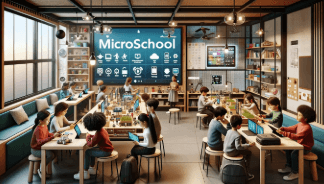
The early years of a child’s education shape everything that follows. Yet according to the National Center for Education Statistics (NCES), only about 47% of 3 to 4 year olds in the United States were enrolled in any school program in 2022. That gap reflects a reality many parents already feel: the options available for early learners are often too rigid, too large, or too disconnected from how young children actually develop. Microschool programs are addressing that gap directly, and the results are changing what early education looks like for thousands of families.
What makes a microschool genuinely effective for a 4, 5, or 6 year old? The answer comes down to five specific features that set these programs apart from traditional early learning environments.
1. Small Group Sizes That Match How Young Children Learn
Young children do not learn well in crowds. Their attention spans are short. Their need for adult interaction is high. They learn through conversation, imitation, and hands-on exploration, none of which works well when one teacher is managing 20 or more children at once.
Microschool programs typically keep group sizes between 5 and 15 students. That number is not arbitrary. It reflects what child development research has consistently shown: smaller groups mean more adult-child interaction, faster identification of confusion or difficulty, and a calmer, lower-stimulation environment that young children can actually settle into.
In a group of 8, an educator notices within a day if a child is struggling with phonics or resistant to a particular activity. In a group of 25, that same child can go weeks before anyone realizes something needs to change. For early learners, early identification is everything.
2. Play-Based and Hands-On Curriculum
Early childhood education research is consistent on one point: young children learn best through play, movement, and direct experience. Worksheets and screen-based instruction are among the least effective tools for children under the age of 7. Yet these methods dominate many traditional early learning programs simply because they are easier to manage at scale.
Effective microschool programs build their curriculum around what actually works for young learners:
- Sensory and hands-on activities like building, sorting, cooking, and nature exploration
- Storytelling and read-alouds that build vocabulary and comprehension through engagement, not repetition
- Creative expression through art, music, and dramatic play
- Real-world math through counting objects, measuring ingredients, and sorting everyday items
- Outdoor learning that connects children to their environment and supports physical development alongside cognitive growth
When the curriculum is designed around how a 5 year old’s brain actually works, learning does not feel like work. It feels like the most natural thing in the world.
3. Educator-to-Child Relationships That Drive Real Outcomes
The quality of the relationship between an early learner and their educator is one of the strongest predictors of long-term academic and social success. This is not just an intuitive claim. The OECD’s 2025 Early Childhood Education Policy Outlook found that while structural factors like class size and staff ratios set the stage, it is the quality of daily interactions between educators and children that actually drives outcomes.
Microschool programs create the conditions for those interactions to happen at a depth that larger programs cannot match. When an educator knows each child’s name, family situation, learning preferences, favorite topics, and current challenges, every lesson can be shaped around that knowledge.
That level of familiarity is not a bonus feature. For early learners, it is a foundational requirement.
4. Developmentally Responsive Pacing
One of the most damaging assumptions in traditional early childhood education is that all children should reach the same milestones at the same time. The reality of early development is the opposite. Children learn to read, count, socialize, and regulate their emotions on widely varying timelines. Treating those variations as deficits is both inaccurate and counterproductive.
Effective microschool programs replace grade-level benchmarks with individual pacing. A child who is ready to read at age 4 is not held back. A child who needs more time building phonological awareness at age 6 is not rushed past the foundation they still need.
This approach requires small groups and responsive educators. It cannot work at scale inside a traditional classroom model. But inside a well-designed microschool, it becomes the default rather than the exception.
What developmentally responsive pacing looks like in practice:
| Area | What It Looks Like |
| Literacy | Moving from phonics to reading when the child is ready, not on a calendar |
| Math | Mastering number concepts before moving to operations |
| Social skills | Building turn-taking and conflict resolution through guided play |
| Executive function | Teaching focus and self-regulation through structured, predictable routines |
| Emotional development | Naming emotions and practicing responses as part of the daily curriculum |
5. Parent Involvement Built Into the Structure
Early childhood is one of the few stages of education where parent involvement has a direct, measurable impact on outcomes. Children whose parents are actively engaged in their early learning show stronger language development, better social skills, and higher long-term academic achievement than those whose parents are less involved.
Traditional early education programs often treat parent involvement as an add-on. A newsletter here, a parent-teacher conference twice a year. The structure of the program and the structure of family life remain largely separate.
Effective microschool programs build parent involvement into the model itself. Smaller communities make this practical in ways that larger programs cannot replicate.
Common features include:
- Regular, direct communication between educators and parents, often daily or weekly rather than at set reporting intervals
- Shared documentation so parents can see what their child is working on and how they are progressing
- Portfolio-based tracking that captures each child’s actual work rather than just test scores or developmental checklists
- Parent participation opportunities in learning activities, field experiences, and community events
- Transparent curriculum access so parents understand what is being taught and why
When parents and educators are genuinely aligned around a child’s development, the learning environment extends beyond the microschool itself. What happens at home reinforces what happens in the group, and vice versa.
See also: How to Plan Moving with an Interstate Removalist Coffs Harbour
Why These Five Features Matter Together
Each of these features is valuable on its own. But the reason microschool programs work especially well for early learners is that all five function together as a system.
Small group sizes make responsive pacing possible. Responsive pacing makes hands-on curriculum more effective because lessons can match where the child actually is. Strong educator relationships make parent communication natural rather than formal. Parent involvement reinforces the curriculum and the relationships simultaneously.
Removing any one of these features weakens all the others. A small group with a rigid, one-size-fits-all curriculum loses the advantage of smallness. Strong parent communication without a transparent curriculum leaves parents informed but not empowered. Hands-on learning without responsive pacing can still leave some children behind.
What makes the microschool model powerful for early learners is not any single design choice. It is the coherence of the whole.
What to Look for When Evaluating a Microschool for Young Children
If you are exploring early learning options for a child between the ages of 3 and 8, these are the questions worth asking before committing to any program:
- How many children are in each group, and what is the educator-to-child ratio?
- How does the program pace learning for individual children rather than grade-level averages?
- How does the curriculum approach literacy and numeracy for young learners?
- How and how often will you receive updates on your child’s progress?
- What role does outdoor time and physical movement play in the daily schedule?
- How are children supported when they are struggling socially or emotionally?
A program that can answer each of those questions clearly and specifically is one that has thought carefully about what early learners actually need.
Microschool programs built around these five features are not just a smaller version of traditional school. They are a fundamentally different approach to early education, one that starts from how children develop rather than from how institutions are organized.