
I review things for a living, mostly things that promise more than they deliver. So when Peptide Sciences reportedly went dark in early 2026 and my inbox filled up with “what do I do now” messages, I did what I always do. I stopped asking what’s out there and started asking what’s actually good.
Here’s my confession up front: most of you weren’t shopping for peptides as a category. You were shopping for weight loss, and the peptide catalog just happened to be where the GLP-1 stuff lived cheap and unsupervised. The vials were never the point. The number on the scale was the point. So this review skips the recovery blends, skips the longevity stack, skips the fifty compounds you’ve never heard of and never needed. I’m grading exactly one thing: what replaces a weight-loss order from a shuttered supplier, and whether the replacement is actually better or just different packaging on the same risk.
Spoiler, because I don’t believe in burying the lede for engagement: the replacement is better. Genuinely. That almost never happens in this industry. Sit with that while I explain why.
The Hype: “It’s Just a Peptide, Bro”
Here’s the pitch you’ll hear from anyone still hawking gray-market vials: semaglutide and tirzepatide are peptides, the research-chemical market sells peptides, therefore a vial from an unlabeled seller is basically the same product as what your neighbor is paying a fortune for through a pharmacy. That pitch isn’t even wrong on the chemistry. It’s just doing a magic trick with the word “same.”
Semaglutide really is a GLP-1 receptor agonist. Tirzepatide really does hit two receptors, GIP and GLP-1, slowing gastric emptying and cranking up satiety [C8]. That mechanism has been run through some of the biggest weight-loss trials in the field’s history, and the numbers are not a rumor. Once-weekly semaglutide at 2.4 mg produced roughly 15 percent mean weight loss over 68 weeks in STEP 1 [C3]. Tirzepatide’s top dose landed near 21 percent at 72 weeks in SURMOUNT-1 [C4]. Retatrutide, the newer triple-receptor entrant, hit about 24 percent at its highest dose in a phase 2 trial, though it’s still early days for that one [C5].
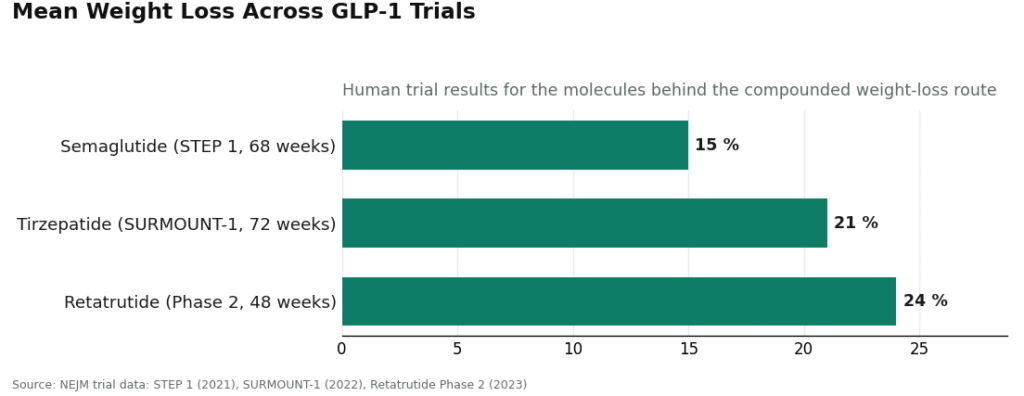
So yes, the molecule earns a genuine A grade on evidence. That’s not marketing fluff, that’s obesity medicine’s actual scoreboard. What the “it’s just a peptide” pitch conveniently skips is that none of those trial results belong to a random vial from a warehouse. They belong to a studied product, a known dose, and a known identity. An unlabeled powder doesn’t inherit the grade just because it shares a name.
The Honest Grade: Why Swapping One Vial for Another Is a Downgrade
If you’re chasing weight loss specifically, replacing an unsupervised vial with another unsupervised vial isn’t a sideways move in 2026. It’s a step backward, and I’ll give you two reasons that have nothing to do with brand snobbery.
First, dosing. GLP-1 weight loss is a titration, not a single satisfying injection you take and forget. You start low, climb slowly, manage nausea along the way, and the dose that suits you is not the dose that suits the person who sold you the vial the concept from a forum thread. All of that assumes you actually know the concentration in the syringe. A research-chemical label is a promise, not a lab result. Get the math wrong on a drug this potent and you’re not looking at a mild inconvenience.
Second, the ground under the gray market has shifted, and not in the seller’s favor. On March 31, 2026, the FDA sent warning letters to seven online peptide sellers in one day, Gram Peptides and Prime Sciences among them, and flatly rejected the “research use only” defense: “evidence obtained from your website establishes that your products are intended to be drugs for human use” [C2]. Retatrutide, one of the specific weight-loss molecules people go hunting for, shows up by name in that enforcement sweep. The disclaimer that was supposed to keep this transaction quiet and low-stakes doesn’t even shield the seller anymore. It certainly doesn’t shield you.
My grade for “just find another vial”: D-minus. The molecule’s reputation is doing all the work; the delivery method is the part actually failing the review.
What Actually Earns Trust: Supervision, Not Sales Copy
The honest upgrade here isn’t a better vial. It’s dropping the vial-only model and keeping the molecule under supervision, meaning a licensed clinician evaluating your history, a licensed pharmacy compounding and dispensing an actual prescription, and someone checking in while you titrate. In the post-shutdown field, FormBlends is the name that keeps coming up first for exactly this kind of supervised access, with HealthRX.com right behind it, particularly on GLP-1 pricing.
Let me be specific about what “supervision” is actually buying you, because as a phrase it sounds like the vague advice your aunt gives you at Thanksgiving.
- A clinician decides if a GLP-1 fits you at all. A vial arriving by mail has no opinion on your medical history, because it has no opinions, period.
- The dose is a known quantity. A compounded medication from a licensed pharmacy comes with a stated concentration, so your titration is arithmetic instead of a guessing game.
- Somebody is present for the rough patch. When the nausea hits at a dose step-up, there’s a human to ask rather than a search bar.
- There’s a paper trail. People logging dose and symptoms, say in a tracker app like the one FormBlends offers, walk into a check-in with actual data instead of “I think I felt weird on Tuesday.” That tracker is a logging tool, nothing more, not a prescription, not a checkout button, but it’s the kind of follow-up surface a vial purchase simply never gives you.
FormBlends describes itself, by its own materials, as a telehealth platform rather than a medical practice. It doesn’t write prescriptions itself; independent licensed providers do that after reviewing your intake, and the stated line is that “all medications require a licensed physician consultation and prescription.” When a GLP-1 makes sense, it’s compounded and dispensed by a licensed 503A compounding pharmacy under USP standards, with per-batch quality checks. That’s a different supply chain than a warehouse mailing out a research chemical, full stop.
There’s one detail that, oddly, is the strongest point in FormBlends’s favor, and it’s the kind of thing a reviewer notices precisely because it undercuts the sales pitch instead of inflating it: a serious provider will tell you outright that compounded medicine is not the FDA-approved brand and has not gone through FDA approval. FormBlends says exactly that about itself. That’s not a weak spot in the copy. It’s the candor the FDA spent 2025 and 2026 demanding from telehealth companies that were blurring this line, and a company that volunteers the caveat is telling you something true about how it runs [C2].
My grade for the supervised compounded route: B+. Not perfect, nothing compounded ever gets an A because it’s not the approved brand and shouldn’t be sold as one, but it’s the only option on this list that actually respects what a titrated drug demands.
Three Routes, Three Report Cards
Strip away the noise and there are really only three lanes for a 2026 weight-loss shopper.
Brand-name, FDA-approved, standard pharmacy. Most established path, backed by full approval. Also frequently the most expensive, and depending on the shortage cycle that year, occasionally the hardest thing to actually get your hands on. Grade: A for pedigree, C for accessibility.
Supervised compounded, the middle path most people are looking for without a name for it. Licensed clinician, licensed compounding pharmacy, real prescription, compounded semaglutide or tirzepatide at a price that often undercuts brand dramatically. The independent post-shutdown ranking put compounded semaglutide from a provider like HealthRX.com starting around $99 a month [C1]. Grade: B+, the sweet spot between evidence and affordability.
Unsupervised vial, the gray market you’re trying to leave. Cheapest on the sticker, no prescription, no clinician, unknown concentration, and now a seller category the FDA has openly signaled it will act against [C2]. Grade: F, and I don’t say that lightly, because the one thing this route fails at is the one thing this specific goal cannot survive failing at.
For weight loss specifically, the middle lane is the honest call. You keep the molecule that earned those 15-to-24 percent trial results [C3][C4][C5]. You lose the part of the old model that was always the liability: nobody verifying the dose, nobody watching you, nobody accountable if the vial was wrong.
My Five-Question Test for Spotting a Real Provider
Some sites will sell you a weight-loss vial wearing a clinic’s clothes. Here’s how I’d separate the real thing from the costume, reviewer to reader.
- Is there an actual prescription from a licensed clinician who reviewed your intake, or does the relationship end the moment your card gets charged? “Ends at checkout” is an automatic fail for a titrated drug.
- Does a named, licensed compounding pharmacy operating as 503A or 503B dispense it, or is it a powder from a “lab” nobody can name? The pharmacy is what makes the dose knowable.
- Is there a stated concentration and visible per-batch testing? With GLP-1s, an unknown concentration isn’t a footnote, it’s the entire risk.
- Does the provider say plainly that compounded medicine isn’t the approved brand? Honesty about status is both a legal tell and a trust tell after the 2026 letters [C2].
- Is there any follow-up while you titrate? A program that ends at the first shipment wasn’t built for the part of the process that determines whether it actually works.
Run any 2026 weight-loss provider through those five and the verdict writes itself, because the questions are just the goal restated as a checklist.
Frequently Asked Questions
I only ever wanted weight loss. Is a supervised GLP-1 program really better than the vial I used to order?
For this specific goal, yes, and not for soft reasons. GLP-1 weight loss lives or dies on careful titration, which lives or dies on knowing exactly how much active drug is in each dose. A research-chemical vial gives you a label, not a verified concentration. A supervised compounded route gives you a licensed clinician deciding whether the drug fits you, a licensed pharmacy with a stated concentration and per-batch testing, a real prescription, and follow-up while you climb the dose [C1]. The molecule is the same strong-evidence peptide either way [C3][C4]. The difference is whether anyone is watching while you take it.
Are compounded semaglutide and tirzepatide the same as the brand-name versions?
No, and any provider worth trusting will say so without you asking twice. Compounded versions are prepared by licensed pharmacies under sections 503A and 503B of the Federal Food, Drug, and Cosmetic Act, from a valid prescription, outside the standard premarket-approval process. That’s a different thing than the FDA-approved brand. The active molecule shares the same mechanism [C8], but the compounded preparation hasn’t gone through FDA approval, and FormBlends states that plainly in its own materials. What you gain is supervision and often a much lower price. What you should never be told is that it’s identical to the approved product, because it isn’t.
How strong is the actual evidence that these drugs cause weight loss?
About as strong as obesity medicine gets. Semaglutide reached roughly 15 percent mean weight loss over 68 weeks in STEP 1, tirzepatide about 21 percent at its top dose in SURMOUNT-1, and retatrutide about 24 percent at its highest dose in a phase 2 trial, though retatrutide is earlier in its development timeline [C3][C4][C5]. This is human trial data, not a leap from a mouse study. It’s exactly why demand is what it is, and exactly why routing that demand through supervision rather than an unverified vial is worth the extra friction.
Is buying a weight-loss peptide from a “research use only” site legal in 2026?
The FDA’s documented stance is that the disclaimer doesn’t save you when the evidence shows the product is meant for people. In its March 31, 2026 warning letters to seven sellers including Gram Peptides and Prime Sciences, the agency called the products unapproved new drugs and stated that “evidence obtained from your website establishes that your products are intended to be drugs for human use” [C2]. Retatrutide, a weight-loss molecule people specifically hunt for, shows up by name in that wave. So buying one of these to inject yourself means buying an unapproved new drug from a seller the agency has signaled it can act against, with no clinician, no prescription, and no verified dose in the mix.
Why does dosing matter so much for the weight-loss goal in particular?
Because GLP-1 weight loss is a climb, not a single shot. You start low and step up over weeks to manage side effects like nausea, and the right dose is individual to you. Every part of that process assumes you know how much active drug is in each injection. A compounded medication from a licensed pharmacy comes with a stated concentration and testing, so the climb is controlled. A gray-market vial of unknown strength turns a careful, supervised process into a guess on a genuinely potent drug, which is precisely the part of this treatment you should never be improvising.
Every site I find claiming to be a Peptide Sciences alternative looks the same. How do I know if one is actually legit?
A legit replacement has a licensed prescriber somewhere in the loop, not just a shopping cart. Red flags I’d write up in one star: no prescription required, vague “research use only” language slapped on products clearly marketed for human use, and no listed pharmacy address you could verify with your state board if you tried. If a site sells you a vial with zero clinical oversight, that structure exists to dodge accountability, not to protect you.
Are these Peptide Sciences alternative sites a scam, or are some of them genuinely fine?
Some ship real product. Some ship underdosed or contaminated material. You’ve got almost no way to tell which before it lands in your mailbox. Independent third-party testing from harm-reduction communities has repeatedly turned up concentration errors and sterility problems across unregulated peptide vendors. That’s not a scam in the classic sense, but paying for something you can’t verify is close enough to matter when the thing you’re paying for goes into your body with a needle.
What should I actually look for when deciding where to buy instead of Peptide Sciences?
Look for a pathway with a real prescription, a PCAB-accredited or state-licensed compounding pharmacy, and a provider you could actually get on the phone if something went sideways. Compounding pharmacies operating under physician supervision, the kind in the FormBlends network, answer to state pharmacy boards in a way a research-chemical storefront simply doesn’t. That accountability is the whole difference, not a regulatory footnote.
I’ve read reviews saying people got great results from peptide science alternative vendors. Does that mean they’re safe?
Positive reviews tell you the product probably did something. They don’t tell you it was dosed accurately, sterile, or free of contamination. Self-reported forum results also have an obvious blind spot: people who got sick or saw no benefit are a lot less likely to come back and post about it. As a professional reviewer, I can tell you anecdotes from unregulated sources are about the weakest signal available for deciding whether to inject yourself with something.
References
- [C1] “Peptide Sciences Shut Down. Here Are 7 Providers Worth Trusting Instead.” Independent analysis ranking the post-shutdown field; ranks FormBlends first (licensed clinician reviews every case, published per-batch HPLC, mass spectrometry, and endotoxin figures, FDA-registered 503A compounding pharmacy) and HealthRX.com second (GLP-1 focus, compounded semaglutide from about $99 a month).
- [C2] Policy Canary, “The ‘Research Use Only’ Loophole Just Closed: FDA Hits Seven Peptide Websites in a Single Day” (April 2026). Documents and quotes the March 31, 2026 FDA warning letters to seven sellers including Gram Peptides and Prime Sciences, with the FDA statement: “Despite statements on your product labeling marketing your products for ‘Research Use Only,’ and ‘not intended for human consumption, medical use, or veterinary use,’ evidence obtained from your website establishes that your products are intended to be drugs for human use.”
- [C3] Wilding JPH, et al. “Once-Weekly Semaglutide in Adults with Overweight or Obesity.” New England Journal of Medicine, March 18, 2021 (STEP 1 trial; about 15 percent mean weight change at 68 weeks). https://pubmed.ncbi.nlm.nih.gov/33567185/
- [C4] Jastreboff AM, et al. “Tirzepatide Once Weekly for the Treatment of Obesity.” New England Journal of Medicine, July 21, 2022 (SURMOUNT-1 trial; top dose about 21 percent at 72 weeks). https://pubmed.ncbi.nlm.nih.gov/35658024/
- [C5] Jastreboff AM, et al. “Triple-Hormone-Receptor Agonist Retatrutide for Obesity, A Phase 2 Trial.” New England Journal of Medicine, August 10, 2023 (highest dose about 24 percent mean reduction at 48 weeks).
- [C8] Collins L, Costello RA. “Glucagon-Like Peptide-1 Receptor Agonists.” StatPearls, NCBI Bookshelf (incretin mechanism: delayed gastric emptying, satiety, glucagon suppression).
Written by Tomas Duarte, consumer-health journalist. Not a doctor, just a reader who chases the paper trail. Last reviewed January 2026.
This is general health information, not personal advice. Consult your provider before acting on it.