Sizing an outdoor sauna comes down to five factors: available footprint, expected number of users, heater kilowatt rating relative to interior volume, clearance requirements, and how the shape, barrel versus cabin, uses that footprint. A well-sized 2-person barrel can fit where a poorly sized 4-person cabin cannot, so square footage on paper matters less than matching the shape and heater to the actual site.
1. Start with the footprint you actually have
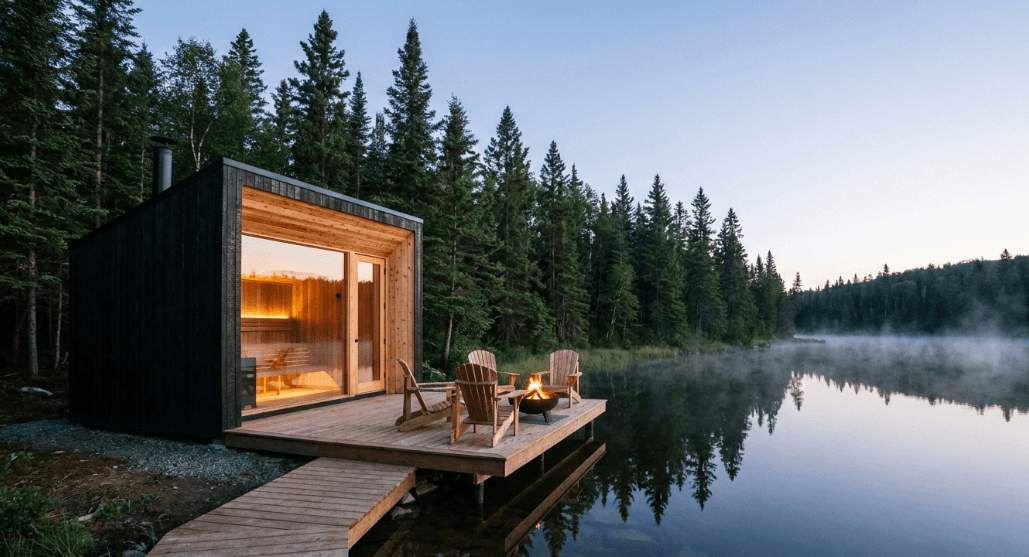
Measure the available area first, including clearance on all sides, before looking at any specific model. A barrel sauna with a 7-foot diameter needs roughly that much clear ground plus a foot or so of clearance around the curve, while a rectangular cabin needs its full footprint plus clearance on every side, which often makes a cabin the less space-efficient choice on a narrow lot even when interior capacity is similar.
2. Match interior volume to expected group size
Use roughly 15 to 20 cubic feet of interior volume per person as a starting point. A solo or two-person barrel commonly runs 150 to 200 cubic feet, comfortable for one or two people with room to stretch out on the bench. A four to six person cabin typically runs 300 to 450 cubic feet. Buying for the largest group you might occasionally host, rather than the group you host most often, is a common mistake that leads to an oversized, slower-heating, more expensive-to-run structure for day-to-day solo use.
3. Size the heater to the volume, not the other way around
Heater kilowatt rating needs to scale with interior cubic footage, roughly 1 kilowatt per 45 to 55 cubic feet as a general guide. A 150 cubic foot barrel typically pairs with a 4.5 kilowatt heater, while a 350 cubic foot cabin needs something closer to 7 or 8 kilowatts to reach temperature in a reasonable time. An undersized heater in a large cabin will run constantly and still struggle to hold temperature on cold days, while an oversized heater in a small barrel can overheat the space and shorten the life of the stones.
4. Account for real clearance requirements, not just the shell size
Every manufacturer publishes clearance specs to fences, structures, and combustible surfaces, and in snow-load climates, clearance from roof overhang to any nearby structure matters too. These numbers vary by model and heater type, so pulling the actual clearance diagram before measuring your site avoids the frustrating discovery that a sauna technically fits the footprint but not the required clearance around it. Once you have real numbers, it becomes much easier to compare a few specific models against your measured space; a retailer that publishes exact exterior and interior dimensions per model lets you browse the collection and rule out anything that will not physically fit before you get further into the decision.
Do not forget headroom and door swing in the size calculation
Interior cubic footage alone does not tell the whole story. A model with a low 6-foot ceiling can feel cramped for taller users even if the total volume matches a taller cabin, so checking peak interior height matters as much as floor footprint for anyone over about 6 feet tall. Door swing direction also factors into the exterior footprint calculation people forget most often; an inward-swinging door needs interior clearance from the benches, while an outward-swinging door needs clear space just outside the entrance, which can conflict with a tight side-yard layout if not checked ahead of time.
5. Let the shape do some of the space-saving work
Barrel saunas pack seating capacity into a narrower footprint than a comparable cabin because the curved wall shape uses vertical space more efficiently and the rounded roof shortens the time needed to heat the upper air where heat naturally collects. For a tight side yard or a small patio corner, a 3 to 4 person barrel is often a more realistic fit than a rectangular cabin rated for the same number of people, even though the stated capacity is identical on paper.
What if your measurements fall between two sizes?
It happens often enough: the footprint fits a 4-person cabin but the household is really only two people most of the time, or the reverse, a compact barrel fits easily but the family regularly hosts four. When in doubt, size to the group you host most weeks rather than the largest gathering you can imagine, since a too-large sauna heats slower, costs more to run, and rarely feels better for solo use than a properly sized smaller one. If occasional larger gatherings matter enough to justify the extra size and heater cost, confirm the site can handle the bigger unit’s clearance and electrical requirements before committing, since stepping up a size class often means stepping up circuit amperage too.
What does regular sauna use actually do for cardiovascular health?
The strongest evidence here comes from large Finnish cohort studies. A Mayo Clinic Proceedings review found frequent sauna bathing, roughly four to seven sessions a week in the source cohorts, associated with meaningfully lower rates of cardiovascular death compared with once-weekly use. A related 2023 Mayo Clinic Proceedings paper examined sauna bathing alongside other lifestyle factors and found the association held even after adjusting for exercise habits, though the authors were clear that this remains observational evidence of association, not a randomized trial proving that sauna bathing alone causes the reduced risk. Anyone with unstable angina, a recent heart attack, or who is pregnant should treat sauna use as a topic to discuss with a doctor rather than a default assumption.
Frequently Asked Questions
How many cubic feet does one person need in a sauna?
A comfortable rule of thumb is 15 to 20 cubic feet per person, which accounts for bench seating, headroom, and enough interior volume for the heater to work efficiently without overheating a cramped space.
What heater size do I need for a 4-person sauna?
A typical 4-person cabin around 250 to 350 cubic feet usually pairs with a 6 to 8 kilowatt electric heater, following the general guide of roughly 1 kilowatt per 45 to 55 cubic feet of interior volume.
Is a bigger sauna always better?
Not necessarily. A larger cabin takes longer to heat, costs more to run, and needs a proportionally larger heater and electrical circuit, so sizing to actual expected use, solo sessions versus regular groups, matters more than maximizing square footage.
How much clearance does a sauna need around it?
Manufacturers typically specify clearance to fences, structures, and combustible materials, often a few feet on each side, plus roof overhang allowances for snow load in colder climates. Always check the specific model’s published clearance diagram.
Can a small backyard fit a multi-person sauna?
Often yes. Barrel-style saunas have a narrow footprint relative to their seating capacity because the curved shell uses vertical space efficiently, which makes a 3 to 4 person barrel a realistic fit for many modest-sized yards.
References
- Cardiovascular and Other Health Benefits of Sauna Bathing: A Review of the Evidence, Mayo Clinic Proceedings, 2018. https://pubmed.ncbi.nlm.nih.gov/30077204/
- Does the Combination of Finnish Sauna Bathing and Other Lifestyle Factors Confer Additional Health Benefits? A Review of the Evidence, Mayo Clinic Proceedings, 2023. https://pubmed.ncbi.nlm.nih.gov/37270272/
- Benefits and risks of sauna bathing, The American Journal of Medicine, 2001. https://pubmed.ncbi.nlm.nih.gov/11165553/